

By Travel Plans Marrakech
📍 Morocco
🏜️ Desert Travel Guide
⏱️ Reading time: 12 minutes
Last updated: July 2026
When most people picture the Sahara, they imagine endless golden dunes, camel caravans and silence stretching to the horizon. Morocco offers all of that, but the reality is far richer.
The country’s desert regions include rocky plateaus, green oases, dry valleys, historic trading towns and communities that have adapted to the climate for generations. The journey to the dunes is also part of the experience. From Marrakech, the road crosses the High Atlas Mountains before passing kasbahs, palm groves and dramatic southern landscapes.
These Sahara Desert facts focus on Morocco and its best-known desert destinations. You will learn about Merzouga, Erg Chebbi, M’Hamid and Erg Chigaga. You will also discover how desert animals survive, why nights can be cold and whether Agafay is really part of the Sahara.
Some facts may surprise you. The Sahara is not entirely covered in sand, camel riding is not compulsory, and a three-day tour from Marrakech is not always the most comfortable option.
Here are 25 useful facts to know before visiting the Moroccan Sahara.
Ready to Explore the Moroccan Sahara?
Discover the desert with a private tour from Marrakech.
Quick Sahara Desert Facts About Morocco
Before exploring each topic, here is a quick overview:
- The Sahara is the largest hot desert in the world.
- Morocco lies on the northwestern edge of the Sahara.
- The country’s two best-known dune fields are Erg Chebbi and Erg Chigaga.
- Merzouga is the main gateway to Erg Chebbi.
- M’Hamid is a common starting point for trips to Erg Chigaga.
- Much of the desert is rocky rather than sandy.
- Desert nights can be cold, especially in winter.
- A journey from Marrakech generally requires at least three days.
- Agafay is an arid landscape, but it is not part of the Sahara.
Where Is the Sahara Desert in Morocco?
1. Morocco contains part of the wider Sahara
The Sahara stretches across much of North Africa. Morocco contains part of its northwestern region, mainly in the south and southeast of the country.
However, not every dry area in southern Morocco is technically part of the Sahara. Landscapes gradually change as you travel beyond the Atlas Mountains. Green valleys become drier, palm groves become less frequent, and rocky plains eventually lead towards the famous dunes.
For most travellers, the main Moroccan Sahara destinations are Merzouga and M’Hamid El Ghizlane.
2. Merzouga is the gateway to Erg Chebbi
Merzouga is a small desert village in southeastern Morocco. It sits directly beside Erg Chebbi, one of the country’s most famous dune fields.
Its location makes it relatively easy to access compared with more remote desert areas. Visitors can reach guesthouses and camps by road before continuing into the dunes on foot, by dromedary or in a four-wheel-drive vehicle.
Merzouga is popular because it combines striking scenery with a wide range of accommodation and activities.
3. M’Hamid is the gateway to Erg Chigaga
M’Hamid El Ghizlane lies farther southwest, beyond Zagora and the Drâa Valley. It is often described as one of the last oasis settlements before the open desert.
From M’Hamid, travellers continue across rough tracks towards Erg Chigaga. The journey normally requires a suitable off-road vehicle.
This extra distance makes the experience feel more isolated. It also requires more planning than a standard overnight stay near Merzouga.
4. The Sahara is not a day trip from Marrakech
The real Sahara dunes are too far from Marrakech for a comfortable day trip.
A journey to Merzouga involves crossing the High Atlas Mountains and travelling through Ouarzazate, the Dadès Valley and several southern towns. Reaching M’Hamid also takes time because the route continues through the Drâa Valley and Zagora.
Some advertisements may make the journey appear short. In reality, visitors should expect long driving distances.
A three-day tour is possible, but four days usually provide a more relaxed experience.
Would you like to explore the Moroccan Sahara at a comfortable pace?
The Moroccan Sahara Is Not Only Sand
5. Most of the Sahara is not covered in dunes
One of the most surprising Sahara Desert facts is that only part of the region consists of sand dunes.
Much of the Moroccan Sahara is made up of rocky plains, dry valleys, mountains and gravel-covered surfaces. Travellers often cross these open landscapes before reaching Erg Chebbi or Erg Chigaga.
The scenery may look empty at first. However, changes in colour, light and rock formations make each section different.
6. An erg is a large dune field
The word erg describes a wide area covered by wind-shaped sand dunes.
Morocco has two famous ergs that are regularly visited by travellers:
- Erg Chebbi, beside Merzouga;
- Erg Chigaga, beyond M’Hamid.
These dune fields are separate destinations. They should not be confused with every sandy area found in southern Morocco.
7. A hamada is a rocky desert plateau
A hamada is a hard, rocky desert landscape with little loose sand.
Travellers may spend hours crossing hamada scenery before seeing the large golden dunes they expected. These flat, open areas are an important part of the Sahara.
They can feel quiet and remote, especially when there are no buildings or villages nearby.
8. Sand dunes constantly change shape
Desert dunes may appear permanent, but wind is always reshaping their surface.
Sand moves along the slopes and creates new ridges, patterns and curves. After strong winds, footprints and vehicle tracks can disappear quickly.
The entire dune field does not suddenly move overnight. Instead, its surface changes gradually over time.
9. Desert colours change throughout the day
The dunes can look pale gold in the morning, orange in the afternoon and deep red near sunset.
Light, clouds and wind all affect their appearance. This is why sunrise and sunset are such memorable moments in the Moroccan Sahara.
However, the experience is not only about taking photographs. Early morning and late afternoon are also cooler and more comfortable for walking.
Oases and Water in the Moroccan Sahara
10. An oasis is more than a group of palm trees
Oases support life in areas where water is limited.
They may include homes, gardens, palm groves and cultivated land. Date palms provide shade, while smaller crops can grow beneath them.
Many southern Moroccan communities developed around reliable water sources. As a result, oases became important places for farming, rest and trade.
11. Traditional irrigation remains important
Water has always been carefully managed in Morocco’s dry regions.
Traditional channels and underground systems helped communities move water from springs or wells towards fields and palm groves. These methods allowed agriculture to continue in demanding conditions.
Today, water scarcity remains a serious concern. Visitors should therefore use water responsibly, especially in remote accommodation.
12. Seasonal lakes can appear near the desert
Near Merzouga, Dayet Srij is a seasonal lake that may hold water after periods of rain.
When conditions are suitable, the lake creates an unexpected contrast with the nearby dunes. Birds may also visit the area.
However, it is important to understand that the lake does not always contain water. Its appearance depends on rainfall and seasonal conditions.
Discover More Than the Dunes
Explore Merzouga and the Moroccan Sahara on a private tour.
Moroccan Sahara Climate Facts
13. Desert days and nights can feel completely different
The Sahara is known for heat, but temperatures can drop quickly after sunset.
Dry air does not retain warmth in the same way as humid air. As a result, a warm afternoon may be followed by a cool or cold night.
This change is especially noticeable during winter. Travellers should not pack only light summer clothing.
14. Winter nights can be very cold
December, January and February often offer pleasant daytime conditions. Yet nights inside desert camps can feel cold.
A comfortable bed and thick blankets make a real difference. Heating is not available in every camp, so it is best to check before booking.
Bring a warm jacket, long trousers and closed shoes. Layers are more useful than one very heavy item.
15. Summer can be extremely demanding
June, July and August can bring intense daytime heat.
Walking on exposed sand becomes uncomfortable during the hottest part of the day. Some activities may be moved to early morning or late afternoon, while certain camps may operate with limited services.
Summer trips require careful planning, reliable transport and plenty of water. They may not be suitable for very young children or travellers who struggle with heat.
16. Rain is rare but not impossible
Rainfall in the desert is limited and irregular. However, storms can still occur.
Heavy rain may affect roads, desert tracks and dry riverbeds. Even distant rainfall can create difficult conditions in low areas.
For this reason, local advice is important. A professional driver can adjust the route when necessary.
17. Wind can change the experience
Wind is a natural part of desert weather.
A light breeze can make warm conditions more pleasant. Stronger winds, however, may reduce visibility and send sand into clothes, bags and cameras.
A scarf, sunglasses and a closed bag for electronic equipment can be useful.
Animals and Plants of the Moroccan Sahara
18. Many desert animals are active at night
Wildlife exists in the Sahara, but visitors do not always see it.
Many animals avoid the strongest daytime heat. They hide in burrows, under rocks or in shaded areas before becoming active after sunset.
Small mammals, reptiles, insects and birds have developed different ways to survive with limited water.
19. Dromedaries are usually domesticated
The animals commonly called camels in Morocco are generally dromedaries. They have one hump.
For centuries, people used them to transport goods and travel across dry regions. Today, trained dromedaries are also used for short tourist rides.
Most dromedaries seen near camps are domesticated rather than wild.
20. A camel ride is not compulsory
Visitors sometimes believe they must ride a dromedary to reach their camp. That is not always true.
Many camps can arrange a four-wheel-drive transfer. This option may suit older travellers, families with small children or anyone who does not feel comfortable riding.
Access depends on the camp, so the transfer method should be confirmed before arrival.
21. Desert plants are built to survive
The Moroccan Sahara is not completely without vegetation.
Acacia trees, tamarisks, date palms and hardy shrubs grow in different areas. Some plants have deep roots, while others have small leaves that reduce water loss.
After rainfall, certain landscapes may briefly become greener than expected.
Experience Morocco’s Desert Heritage
Travel through ancient caravan routes, oases and kasbahs on your way to the Sahara.
History and Culture of the Moroccan Sahara
22. Southern Morocco was connected to caravan trade
For centuries, trade routes crossed the Sahara and connected North Africa with regions farther south.
Caravans carried salt, textiles, metals and other goods. Oasis settlements became important places to rest, exchange products and obtain water.
Rissani, near Merzouga, developed close to the historic trading city of Sijilmassa. The area still reflects this commercial past.
23. The desert is home to living communities
The Sahara is not empty.
Families live in towns, villages and oasis settlements throughout southern Morocco. The region reflects Amazigh, Arab, Sahrawi, Gnawa and other cultural influences.
Some families once followed nomadic or semi-nomadic lifestyles. However, it would be inaccurate to describe everyone in the desert as nomadic today.
Visitors should treat local communities as people rather than attractions. Always ask permission before taking close photographs.
24. Architecture is adapted to the climate
Traditional buildings in southern Morocco often use earth, clay, straw and stone.
Thick walls help interiors remain cooler during the day and warmer at night. Courtyards also create shade and improve airflow.
Kasbahs and fortified villages are not simply decorative landmarks. Their designs reflect local materials, security needs and environmental conditions.
Erg Chebbi or Erg Chigaga: Which Is Better?
Both destinations offer a genuine Sahara experience, but they suit different travellers.
Erg Chebbi
Erg Chebbi is easier to reach because the dunes stand beside Merzouga.
The area offers many hotels, camps and activities. It works well for first-time visitors, families and travellers with limited time.
However, some parts can feel busy during peak travel periods.
Erg Chigaga
Erg Chigaga feels more remote.
Reaching it usually requires an off-road journey from M’Hamid. Camps are more isolated, and the surrounding landscape feels wilder.
It may suit travellers who value quiet surroundings and do not mind a longer journey.
Neither destination is automatically better. The right choice depends on your schedule, comfort expectations and travel style.
Looking for a Desert Escape Near Marrakech?
Discover Agafay with a unique desert experience just outside Marrakech.
25. Agafay Is Not Part of the Sahara
Agafay is a rocky, arid landscape near Marrakech. It is often promoted as a desert because of its dry hills and open views.
However, it is not part of the Sahara and does not have the large natural dune fields found near Merzouga or M’Hamid.
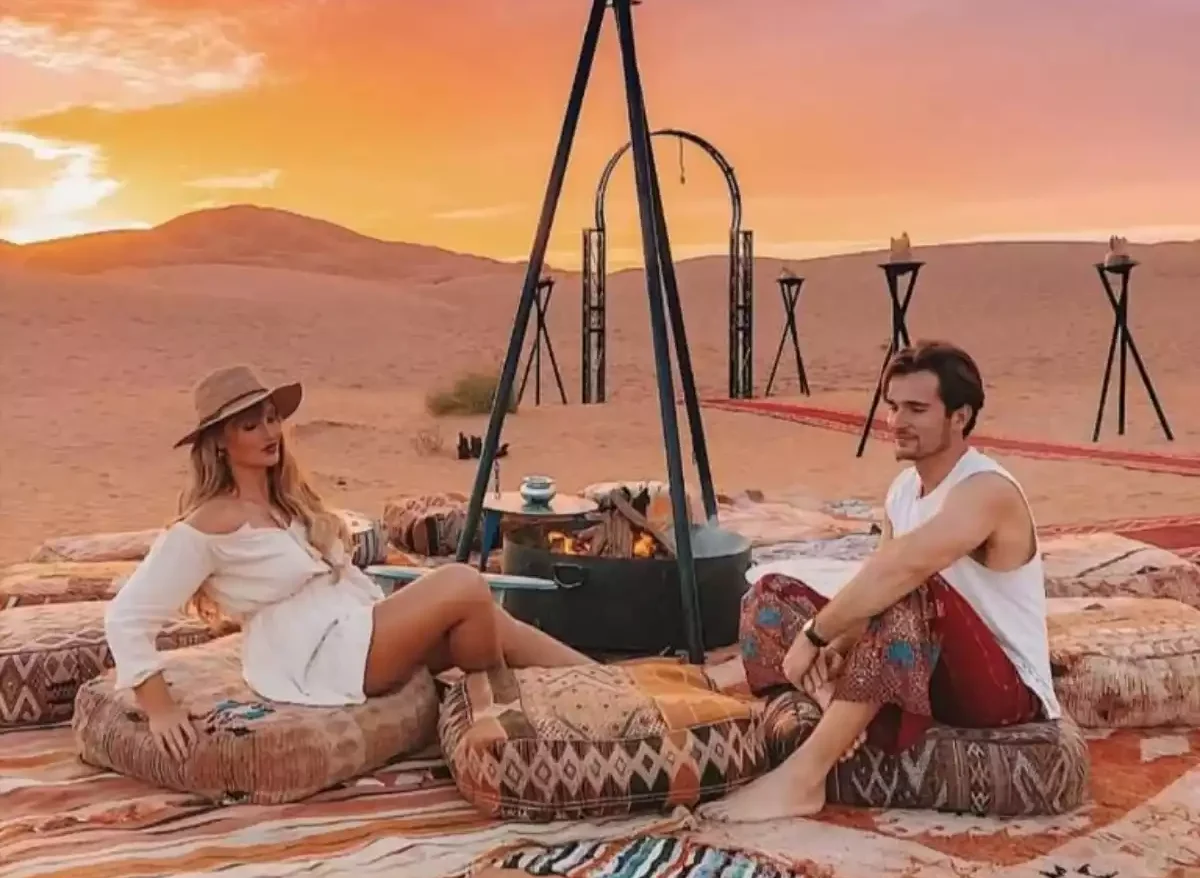
Agafay remains a good option for travellers with limited time. It is suitable for sunset dinners, camel rides, quad activities, pool days and short camp stays.
Visitors seeking a true Sahara journey should choose Erg Chebbi or Erg Chigaga instead.
How to Visit the Sahara Desert From Marrakech
The best itinerary depends on the time available.
A three-day tour
A three-day Marrakech-to-Merzouga tour usually includes:
- one night around the Dadès Valley;
- one night near the dunes;
- a return to Marrakech on the final day.
This route is possible, but it includes long driving hours. The final day is particularly demanding.
A four-day tour
Four days provide more time for rest and cultural stops.
Travellers can explore the route at a calmer pace and spend less of each day inside the vehicle. This option is better for many families, couples and older visitors.
Marrakech to Fes through Merzouga
A Marrakech-to-Fes desert tour avoids returning along the same road.
The route can include the High Atlas, Aït Ben Haddou, the Dadès Valley, Todra Gorge, Merzouga and the Middle Atlas before reaching Fes.
It is a practical choice for travellers continuing their journey through northern Morocco.
A longer private itinerary
Five days or more allow you to experience the south without rushing.
You can include Skoura, Ouarzazate, Rissani, oasis villages or a second night near the dunes. A private itinerary also makes it easier to adapt stops and departure times.
Travel Plans Marrakech can organise private transport, carefully selected accommodation and a route adapted to your schedule.
Practical Tips Before Visiting
Pack for both warm and cold conditions. Light layers work well during the day, while a jacket is important after sunset.
Closed shoes are useful around camps, although sandals can be comfortable during short walks. Bring sun protection, sunglasses and a reusable water bottle.
Do not expect a strong internet connection in every camp. Electricity may also be limited, depending on the location and accommodation category.
Most importantly, avoid planning too much. The desert is best enjoyed slowly. Leave time to watch the sunset, walk quietly and appreciate the changing landscape.
Spend a Magical Night in Merzouga
Sleep in a desert camp and wake up beside the dunes of Erg Chebbi.
Frequently Asked Questions
Is there a Sahara Desert in Morocco?
Yes. Morocco includes Saharan landscapes in the south and southeast of the country. The best-known destinations are Merzouga, beside the Erg Chebbi dunes, and M’Hamid El Ghizlane, the gateway to Erg Chigaga. Both offer genuine Sahara scenery, desert camps and different travel experiences.
Is Merzouga in the Sahara Desert?
Yes. Merzouga is a small village located beside Erg Chebbi, one of Morocco’s most famous Sahara dune fields. It is a popular starting point for camel rides, desert camps, sandboarding and 4×4 excursions. Merzouga is also easier to access than the more remote Erg Chigaga region.
What is the difference between Erg Chebbi and Erg Chigaga?
Erg Chebbi is located beside Merzouga and is easier to reach by road. It offers a wider choice of hotels, camps and activities. Erg Chigaga lies beyond M’Hamid and usually requires an off-road transfer. It is more remote and suits travellers looking for a quieter desert experience.
How many days do you need to visit the Sahara from Marrakech?
Three days is the minimum recommended for a Marrakech-to-Merzouga tour, but the itinerary includes long driving hours. Four days offer a more comfortable pace, with more time to explore the Atlas Mountains, kasbahs, valleys and desert villages. Families and travellers who prefer slower journeys should consider four days or longer.
What is the best time to visit the Sahara Desert in Morocco?
The best time to visit the Moroccan Sahara is generally from October to April, when daytime temperatures are more comfortable. Winter nights can be cold, especially in desert camps. Summer temperatures can become extremely high, so outdoor activities are usually planned early in the morning or near sunset.
Ready to experience the Moroccan Sahara beyond the facts?
Final Thoughts
These Sahara Desert facts show that Morocco’s desert is much more diverse than the images usually seen on postcards.
The experience includes rocky plateaus, palm-filled oases, historic trading routes, traditional architecture and communities that continue to shape the region. Erg Chebbi offers convenient access from Merzouga, while Erg Chigaga provides a more remote journey beyond M’Hamid.
The road from Marrakech is long, but it is also part of the adventure. Travellers cross mountains, valleys, kasbahs and changing landscapes before finally reaching the dunes.
Choosing the right itinerary matters. A rushed trip may leave little time to enjoy the places along the way. Four days or longer usually provide a more balanced experience, especially for families and first-time visitors.
Travel Plans Marrakech can create a private Sahara tour with a professional driver, comfortable transport and accommodation selected according to your preferences.
Get In Touch
Error: Contact form not found.
Contact Us
Phone / Fax: +212 5 24 32 66 88
Mobile: +212 6 08 85 10 10
Whatsapp: +212 6 08 87 20 20
Email: travelplansmarrakech@gmail.com
Opening Hours
Mon - Sat: 9.00 am - 8.00 pm
Sunday: 9.00 am - 6.00 pm
Our Office
13 bis talaint ain itti nakhil nord، 40060 Marrakech


 EN
EN FR
FR ES
ES IT
IT